
Insights, case studies & news
Perspectives on AI-native cyber defense, exposure management, and staying ahead of the threat.
Java4Shell: We Verified OpenJDK's Pre-Auth AVX-512 Base64 Heap Overflow (CVE-2026-114938) on Real Silicon — Here's the Evidence
CVE-2026-114938 (Java4Shell) is a pre-auth heap buffer overflow in the hardware-accelerated Base64 decoder built into OpenJDK 17.0.6+ on x86-64 AVX-512 hardware. The trigger is 512 well-formed Base64 characters followed by a two-character padded fragment. Our pipeline verified it end-to-end against genuine Temurin 17.0.12 on real Sapphire Rapids silicon — the exploit corrupts the heap on the vulnerable build, the -XX:-UseBASE64Intrinsics control stays clean at every gate — and we shipped a disruptive-tier Detection check alongside. The complete evidence, the measured trigger truth table, and what it means for your patch prioritization.
One Line, One Race: We Verified Apache's Critical mod_http2 RCE (CVE-2026-119618) — Here's the Evidence
CVE-2026-119618 is a 9.8-rated unauthenticated RCE in Apache's HTTP/2 module affecting every release from 2.4.55 through 2.4.70, fixed by changing one token in one function. Our pipeline verified it end-to-end against genuine httpd — exploit fired on 2.4.70, clean on the patched 2.4.71 control — and shipped a production check alongside. The complete evidence, the three-attempt verification record, and what it means for your patch prioritization.
Vibe-coded exploits are the new script kiddies
Vibe-coded php2shell exploits (CVE-2026-109618/109619) crash services but rarely achieve code execution — defenders need an exploit harness, not a vibe.
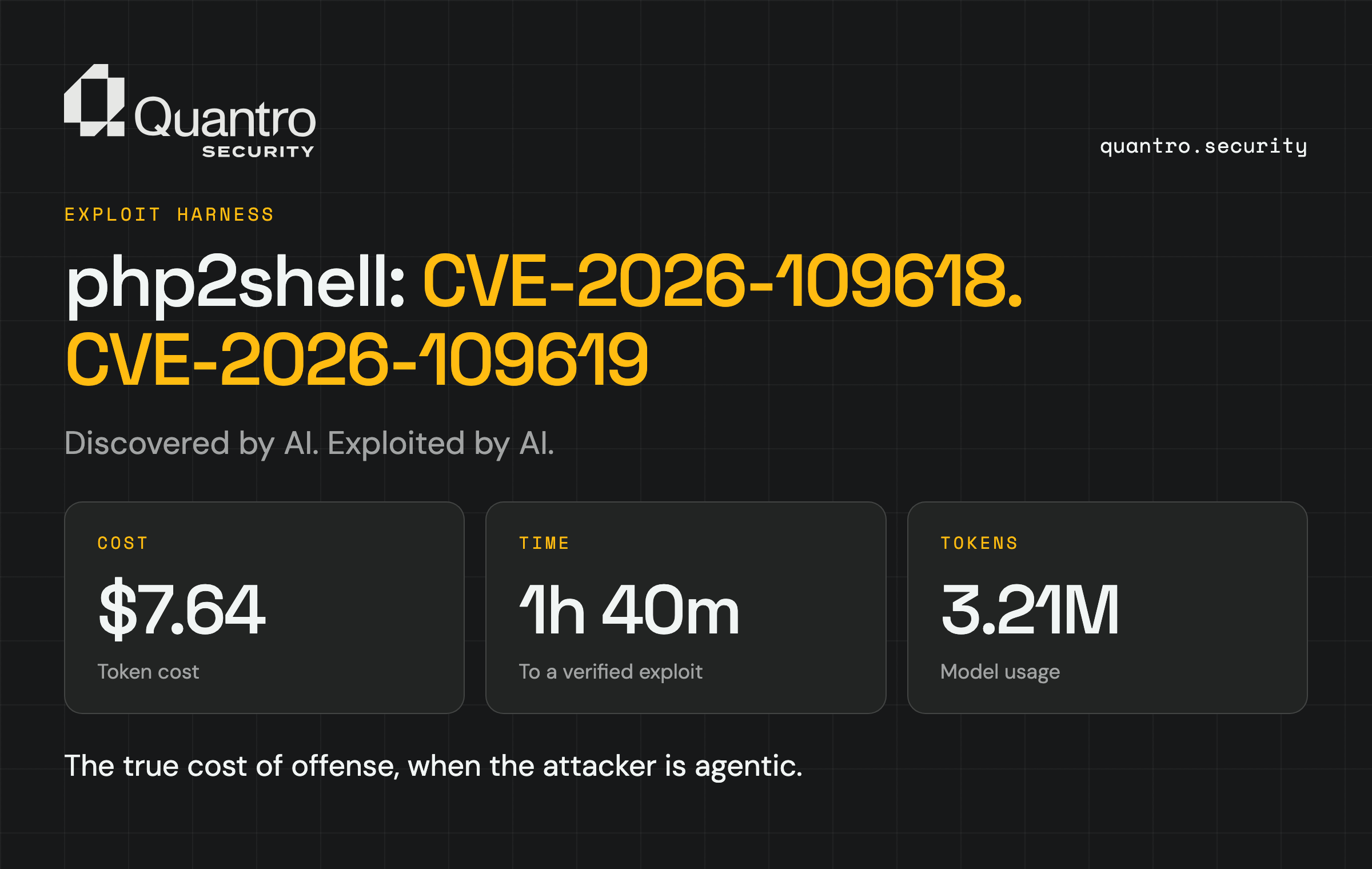
php2shell: CVE-2026-109618 & CVE-2026-109619 RCE
AI models discovered the vulnerability in PHP. We used Quantro's exploit harness to exploit it.
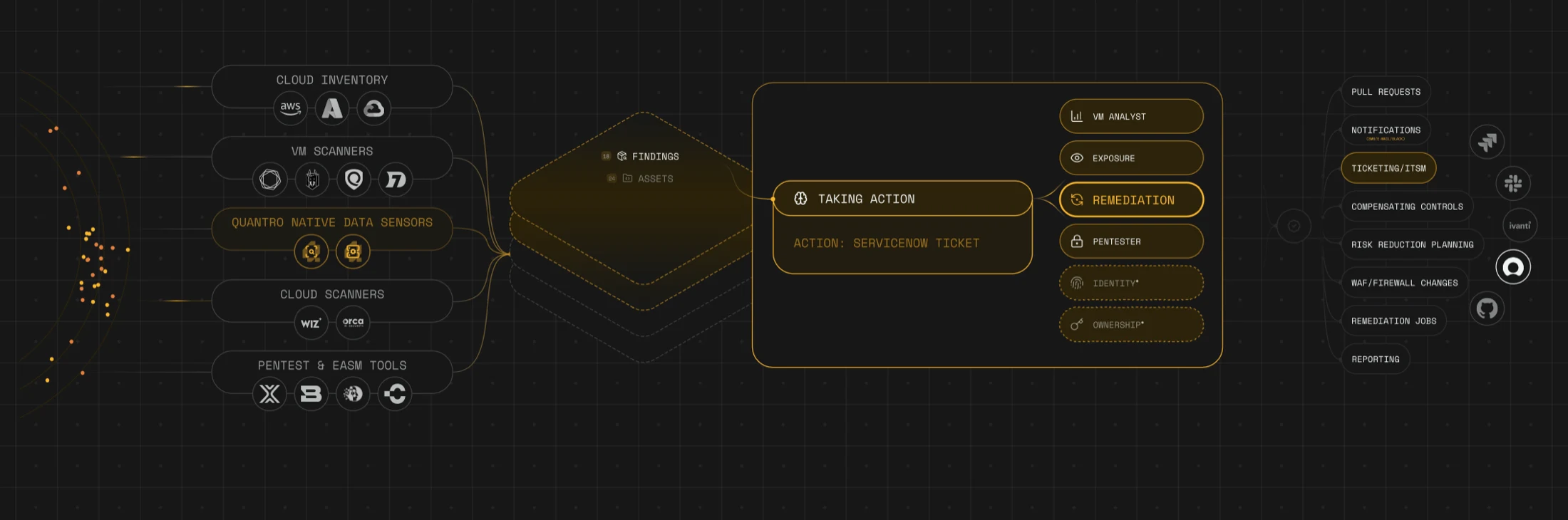
Agentic Vulnerability Management and Agentic CTEM Explained
Agentic vulnerability management uses autonomous AI agents to discover, validate, prioritize, and mitigate exposure in minutes. Here is how agentic CTEM works.

Introducing Vulnerability Research Labs (VRL)
Why we started VRL: to fight FUD with actual research and data, build in the open, and hand defenders practical tools. Independently verified in partnership with Loginsoft.
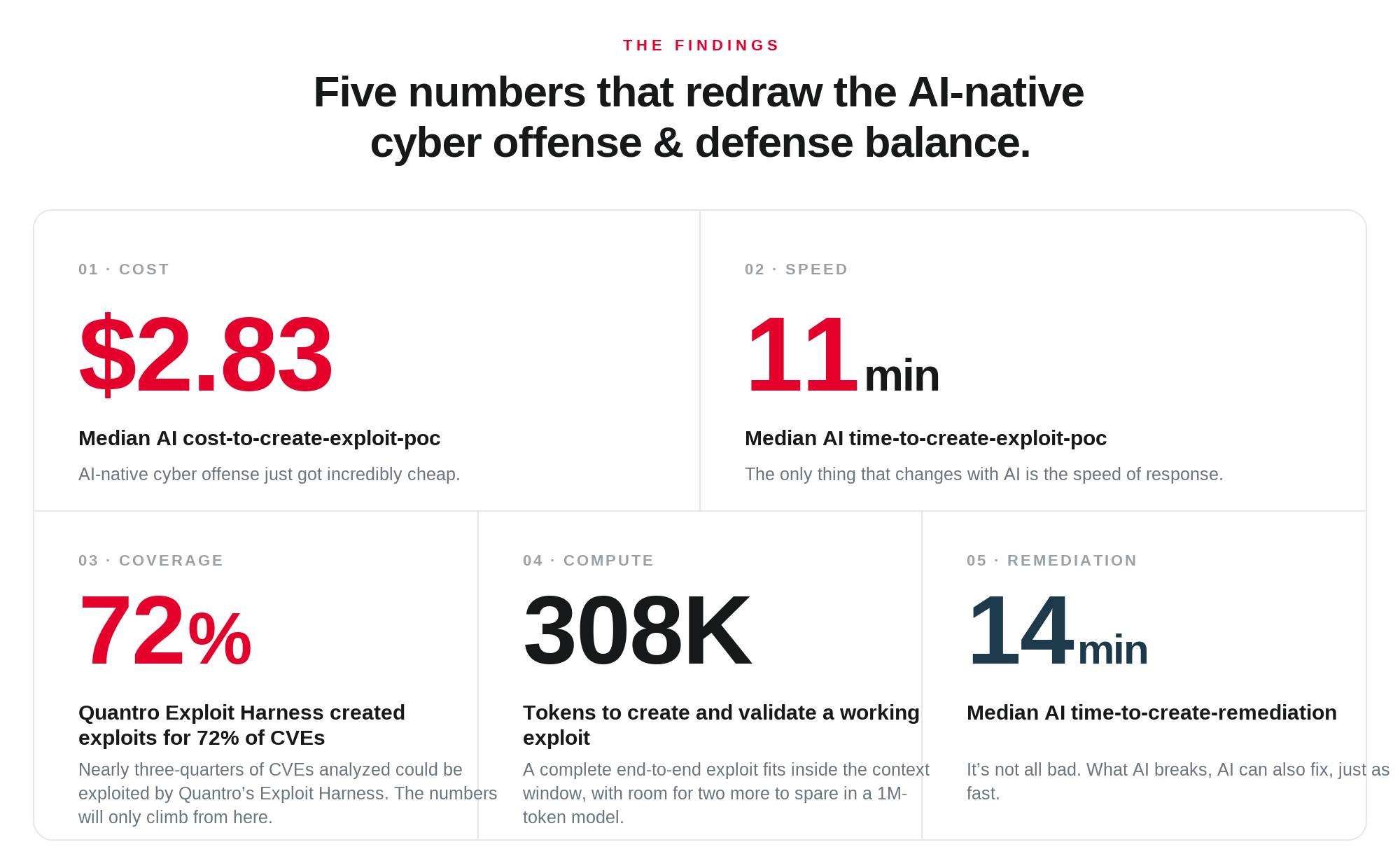
The $3 Exploit: Quantro Security Report Reveals AI Has Collapsed the Economics of Vulnerability Exploitation
Autonomous AI agents turned disclosed CVEs into verified working exploits for a median of $2.83 and 11 minutes each — and the flaws they exploit most easily are the ones today's risk metrics tell defenders to ignore.

Securing the Enterprise Against AI-Native Offense
A founder's take on defending the enterprise when AI collapses the cost of offense — why legacy metrics like CVSS, EPSS, and KEV are dead, the three that matter now, and why defense needs an agentic workforce.

Don't Vibe Code: Why Better Service for Less Wins in the AI Era
AI made building trivial. Maintenance didn't. Why pricing for outcomes — and never having to maintain it yourself — is the strategy that wins in the AI era.
Context Is All You Need
Security tools find issues. Quantro understands what they mean — applying contextual risk reasoning across your entire environment, continuously and at scale.
Our Founding Story: Why We Started Quantro
Two cybersecurity veterans with decades at CrowdStrike, Qualys, and Tenable started Quantro to solve three problems: AI-native threats at machine speed, stagnant security-team productivity, and the expert-talent shortage.
Quantro Security Emerges from Stealth to Reinvent Cyber Defense with Autonomous AI Agents
Quantro emerges from stealth with VM.Analyst — an AI agent that automates vulnerability management and risk remediation, helping security teams outpace AI-native threats at machine speed.
Nothing here yet.